Wood flooring is the biggest single category we cover at Grosvenor Flooring — and the one with the most decisions to make before you buy. Solid or engineered? Plank, herringbone, chevron or Versailles panel? 14mm or 20mm board, 3mm or 6mm wear layer? European oak or something more unusual? Rustic grade with visible character, or prime grade for a calmer surface? And that’s before you get to finishes, fitting methods, and underfloor heating compatibility.
This is the hub for our full library of wood flooring guides, brand reviews, fitting advice, and honest comparisons. We stock and fit wood flooring across Altrincham, Manchester and the whole of Cheshire, and everything you’ll find in this section is written by the same people who spec and fit it day to day — not by a marketing agency who’ve never stood on an oak board.
READ THE LATEST FROM OUR WOOD FLOORING BLOG
Scroll for our full library of wood flooring articles — brand reviews, installation guides, care advice, local project write-ups, and honest comparisons. New posts added regularly as the ranges we stock evolve. If there’s a specific question you want answered that we haven’t covered yet, get in touch — we’d rather write a useful piece than leave a question hanging.
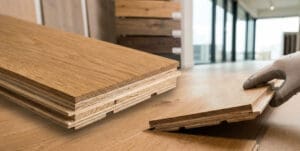
V4 Engineered Wood Flooring Guide
V4 Engineered Wood Flooring: The Complete Brand Guide V4 Wood Flooring is one of the...
10
Apr
Apr
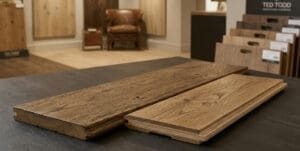
Ted Todd Engineered Wood Flooring Guide
Ted Todd Engineered Wood Flooring: The Complete Brand Guide Ted Todd is arguably the most...
10
Apr
Apr
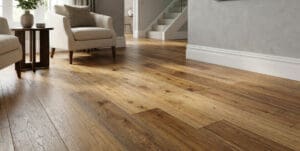
Woodpecker Engineered Wood Flooring Guide
Woodpecker Engineered Wood Flooring: The Complete Brand Guide Woodpecker Flooring is one of the more...
10
Apr
Apr
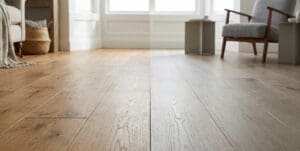
ENGINEERED WOOD OR SOLID WOOD?
For the vast majority of modern UK homes, the honest answer is engineered wood. A properly built engineered board — 14mm or thicker, multi-ply core, 3mm or greater hardwood wear layer — gives you the look, feel and refinishing life of a solid oak floor with dramatically better dimensional stability. It copes with underfloor heating (which solid wood generally doesn’t), handles the humidity swings of a modern home without cupping or gapping, and can be fitted as a floating floor over a wide range of subfloors rather than needing to be nailed down to joists.
Solid wood still has a place — period properties with existing joist structures, restoration projects where matching the original board is the brief, and situations where the homeowner specifically wants the long-term refinishing life that 18–22mm of solid oak gives you. But it’s no longer the default, and on most projects it’s the wrong answer.
Start with our guide to the best engineered wood flooring in the UK for the category overview, and the full engineered wood flooring range for what we actually stock.
BRAND GUIDES — THE UK’S PREMIUM ENGINEERED WOOD
We’ve written honest, spec-level brand guides for the three premium engineered wood names most UK homeowners seriously consider — plus our own in-house GF range, which is designed and sourced direct from European mills to give you the same build quality without the brand premium.
- Woodpecker — Stonehaven, Harlech, Chepstow and the rest of the nine-range engineered line-up explained. Read the complete Woodpecker brand guide, or if you’ve already been quoted, the Woodpecker vs GF comparison and Woodpecker alternatives pieces.
- Ted Todd — Classic Futures, Residence, Warehouse, Project and the rest of the eight-collection line-up broken down properly. Read the complete Ted Todd brand guide, the Ted Todd vs GF comparison, or the Ted Todd alternatives guide.
- V4 — Alpine, Deco, Driftwood, Heritage and Tundra. Read the complete V4 brand guide, or browse the full V4 range in our catalogue.
- GF Engineered Wood — our in-house range, designed and sourced direct from European mills. Browse the full GF collection (planks, herringbone, and Versailles panels).
CHOOSING A FORMAT — PLANK, HERRINGBONE, CHEVRON OR VERSAILLES
The format of the board is almost as important as the species and the finish. It changes the proportion of the room, the price per square metre, the fitting time, and the visual rhythm of the floor. Our category pages for each format cover what’s available, how they compare, and which situations suit which:
- Engineered wood plank — the default format, covering everything from 148mm narrow boards through to 240mm extra-wide.
- Engineered wood herringbone — interlocking blocks in the classic offset pattern, now available in large-format 120 × 600mm as well as traditional smaller blocks.
- Engineered wood chevron — 45° point-to-point blocks, a more formal pattern than herringbone and an increasingly popular choice in design-led projects.
- Engineered wood Versailles — large-format parquet panels with interlocking oak strips, originally specified for Versailles itself. The most traditional look we stock.
For the detail on how these formats behave structurally — and when to pick which — we have dedicated guides at fixed-length plank and random-length plank for the wide-board decision.
INSTALLATION, CARE & UNDERFLOOR HEATING
Buying the right wood floor is only half the job — installing it properly is the other half, and the cheapest engineered oak fitted badly will always outperform the most expensive board fitted wrong. Our installation and care guides cover the practical side:
- Complete installation guide for engineered wood flooring — subfloor prep, acclimatisation, fitting methods, and the decisions that matter.
- Engineered wood flooring care guide — how to clean, what to avoid, and how to keep an oiled or lacquered floor looking right.
On underfloor heating: most of our engineered wood ranges are UFH-compatible, but the specifics depend on board construction, subfloor type, system temperature limits (usually 27°C surface max), and fitting method. We check every option in detail as part of your quote — don’t assume and don’t let another retailer hand-wave it.
WHERE TO SEE IT — OUR ALTRINCHAM WOOD ROOM
Real wood flooring has to be seen in large boards under natural light. Postage-stamp samples tell you almost nothing about how a floor will actually look in your home, and product photography compresses the tonal range in ways that make darker boards look lighter and smoked boards look warmer than they really are. It’s the single biggest reason homeowners end up disappointed with a wood floor they bought online.
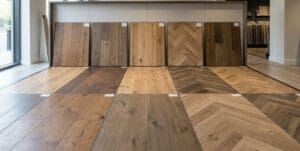
That’s why we built a dedicated Wood Room inside our Altrincham showroom — a purpose-designed space for engineered wood flooring, with the leading UK brands and our exclusive GF range laid out as full-size displays rather than swatches. You can walk on them, compare them directly, see how different finishes catch the light, and make a decision with your eyes rather than your laptop screen.
The showroom is open 24/7 as an unmanned Smart Showroom — you request a door code through our website and visit any hour of any day, including evenings and weekends. Read more on our engineered wood flooring in Altrincham — visit our Wood Room page, or request your Smart Showroom door code now.
SERVING MANCHESTER, CHESHIRE & THE NORTH WEST
Grosvenor Flooring is based in Altrincham, at the centre of the Manchester/Cheshire golden triangle, and we supply and fit wood flooring across the whole region — from the substantial homes of Prestbury, Alderley Edge, Wilmslow and Hale, through the refurbishment projects of Didsbury, Chorlton, Sale and Bramhall, to commercial and residential projects across Manchester, Stockport, Chester and Warrington.
For buyers further afield, we offer nationwide supply-only delivery on every range we stock — including our exclusive GF engineered wood — via the flooring supply section of our site.
WOOD FLOORING — FREQUENTLY ASKED QUESTIONS
Is engineered wood flooring as good as solid wood?
For most modern UK homes, yes — and often better. A good engineered board handles underfloor heating and humidity swings in ways solid wood can’t, and a 6mm hardwood wear layer on a 20mm engineered board has a refinishing life comparable to solid oak. Where solid still wins is in period properties with existing joist structures and in restoration work where matching original boards is the brief.
What thickness and wear layer should I be looking for?
For entry-level engineered wood, 14mm board with a 3mm wear layer is the honest minimum. For a mid-premium floor, 15mm / 4mm is the mainstream spec. For a premium floor intended to last decades and be refinished more than once, look for 20mm or 21mm board with a 5mm or 6mm wear layer. Below 14/3 and you’re in the territory of thin-veneer engineered wood that’s best avoided.
Can I fit engineered wood over underfloor heating?
Most of our engineered wood is UFH-compatible but the specifics matter — subfloor type, system temperature (typically 27°C surface max), board thickness, and fitting method all feed in. We check every combination as part of the quote process. Solid wood generally isn’t suitable for UFH and should be avoided on those projects.
Herringbone or plank?
Plank is the default and the easier answer for most rooms. Herringbone works best in spaces where the pattern itself is part of the design intent — entrance halls, kitchen-diners, formal living rooms — and in larger rooms where the geometric rhythm has space to breathe. Chevron is the more formal cousin. Versailles panels are the most traditional look we stock.
What’s the difference between rustic and prime grade?
Rustic grade shows more of the natural character of the oak — knots, sapwood, colour variation, occasional mineral streaks. Prime grade is calmer, with the character sorted out at the mill. Neither is better; it’s a look choice. Rustic tends to suit older properties and lived-in interiors; prime tends to suit contemporary, design-led schemes.
Do you offer a supply-only option as well as supply and fit?
Both. We fit across Manchester, Cheshire and the North West, and we also supply nationwide via our flooring supply section. For trade customers, we operate a dedicated trade flooring account programme.