






Buying Guides · 9 min read
Alva LVT vs Click SPC: Which Installation Method is Right for Your Project?
In this article
- What’s the difference between LVT and click SPC?
- Alva glue-down LVT vs Alva click SPC: the specifications
- Which one should you choose? A decision framework
- Choose Alva glue-down LVT if…
- Choose Alva click SPC if…
- Edge cases and honest caveats
- Where Alva fits in the wider UK click LVT market
- Ordering and next steps
- Frequently Asked Questions
Key Takeaways
One of the things that makes Alva unusual in the luxury vinyl market is that every design is available in two completely different constructions: a traditional 2.5mm glue-down LVT and a 5.2mm click SPC. Same colour, same grain, same micro-bevelled edges — very different installation, very different suitability. Pick the wrong one and you end up fighting your subfloor, your fitter or your timeline. Pick the right one and the floor lasts decades.
This guide covers the spec differences, which construction suits which project and — because Alva sits inside a much wider UK click LVT market — where Alva fits against the other click LVT brands you might be cross-shopping. We sell and fit both versions of Alva every week; the view below is based on what actually happens on customers’ floors rather than marketing spec sheets.
If you’re starting from scratch, the full range is on the Alva LVT category page. If you want the broader view of value-tier LVT options, our Alva LVT review covers that territory.
What’s the difference between LVT and click SPC?
LVT (Luxury Vinyl Tile) and SPC (Stone Plastic Composite) are both types of vinyl flooring, but they’re constructed very differently and install very differently. The terminology gets muddled in marketing copy, so a short primer is worth having before the spec comparison.
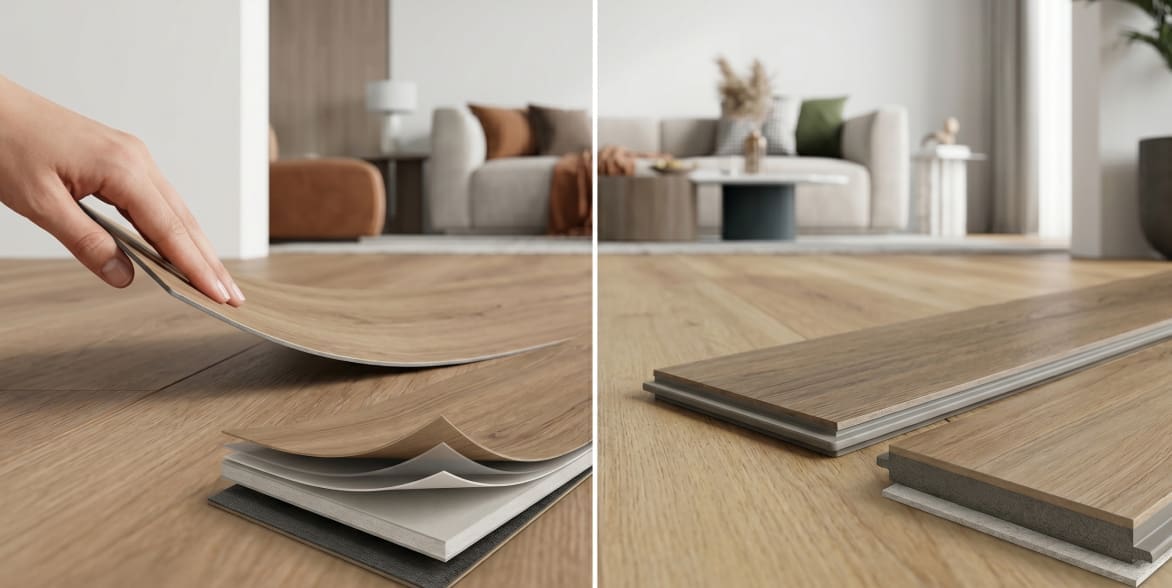
LVT (traditional glue-down). A thinner, more flexible vinyl plank or tile, typically 2-2.5mm thick, bonded to the subfloor with a compatible adhesive. The floor becomes a single bonded surface — quiet, stable, extremely long-lived when installed correctly. Subfloor preparation matters: any imperfection in the subfloor telegraphs through to the finished floor, so the subfloor must be perfectly flat and dry.
Click SPC (rigid core). A much thicker plank, typically 5-6mm, built around a rigid stone-plastic composite core. The planks lock together with an angled click system rather than being bonded to the subfloor — a “floating” floor. The rigid core means the floor tolerates minor subfloor imperfections without telegraphing them through and click installation requires no adhesive. Most click SPC planks ship with an integrated acoustic backing, which replaces a separate underlay.
Both types are fully waterproof. Both can be used with underfloor heating within manufacturer limits. Both are available in wood and stone effects. The choice is genuinely about installation and subfloor, not about whether you can use them in a kitchen or over UFH.

Grosvenor+
Elevate your project with Grosvenor+
Premium membership for professionals and discerning homeowners who demand excellence in every square metre.
- Exclusive pricing & discounts across thousands of flooring products.
- Priority fitting and dedicated project support.
- Member tools — project boards, QR referrals and more.
Alva glue-down LVT vs Alva click SPC: the specifications
Two things jump out of that table. First, the wear layer: 0.55mm on glue-down versus 0.3mm on click SPC is a meaningful spec difference — the glue-down LVT has nearly twice the material between your feet and the design layer and that’s the layer doing the hard work on scratch and stain resistance. If the floor is going into a high-footfall hallway or a commercial space, that 0.55mm is worth reaching for.
Second, the thickness: 5.2mm vs 2.5mm matters when you’re joining onto existing floor heights. Click SPC adds more than double the height of glue-down LVT, which can affect door clearances, threshold heights and thresholds between rooms. If you’re fitting into a room that already has a flush threshold with adjoining rooms, the thickness change can create a ridge that needs a threshold bar to disguise.
| Specification | Alva glue-down LVT | Alva click SPC |
|---|---|---|
| Overall thickness | 2.5mm | 5.2mm |
| Wear layer | 0.55mm | 0.3mm |
| Core construction | Flexible PVC | Rigid stone-plastic composite |
| Plank format | 1,227mm x 187mm | 1,220mm x 180mm |
| Herringbone format | 613mm x 138mm | 630mm x 126mm |
| Tile format | 607mm x 307mm | 600mm x 300mm |
| Installation | Bonded to subfloor with adhesive | Click-lock over integrated acoustic backing |
| Subfloor tolerance | Must be perfectly flat | Tolerates minor irregularities |
| Underlay | None — direct to subfloor | Integrated |
| Warranty | 25 years residential / 15 years commercial | 25 years residential / 15 years commercial |
| Typical install time (20m2 room) | 1-1.5 days with drying | Under a day, no drying required |
Which one should you choose? A decision framework
There isn’t a universal right answer. The correct choice depends on four factors: your subfloor, your timeline, whether you’re using a professional fitter and what room type the floor is going into.
Choose Alva glue-down LVT if…
…your subfloor is new, flat and dry. New-build properties, recently-levelled screeds, properly-prepared plywood over joists — all ideal candidates. Glue-down rewards a good subfloor and punishes a bad one.
…the floor needs to last decades without remedial work. Bonded to the subfloor, glue-down LVT is the longer-lived construction in practice. The thicker wear layer and the lack of joint movement mean the floor ages more gracefully over 15+ years than a click floor typically does.
…you want the quietest floor underfoot. A bonded floor transmits less footstep noise to the subfloor and generates less reverb in the room — useful in bedrooms and lounges in particular.
…you’re fitting a large, open-plan space. Large continuous runs work better glued. Click systems need expansion gaps at every fixed edge — on a big open area, that’s a lot of edge.
…the room is a kitchen with heavy appliances. Stationary heavy loads (American fridges, range cookers) can compress click-SPC joints over time. Glue-down sits directly on the subfloor and doesn’t have that concern.
…you’re paying a professional fitter and budget isn’t the primary driver. Good glue-down LVT, correctly installed, is the strongest residential LVT outcome money can buy at this price point. If you’re already paying for fitting, the fit premium for glue-down over click is marginal.
Choose Alva click SPC if…
…your subfloor has minor imperfections you can’t easily fix. Older concrete with minor cracks, existing tile you don’t want to rip up, slightly uneven floorboards — click SPC is engineered to tolerate these. Glue-down is not.
…you’re fitting yourself (DIY). Click systems are meaningfully easier to fit correctly than glue-down. If you’re confident with basic measuring and cutting, a click SPC floor is genuinely achievable over a weekend. Glue-down requires subfloor prep, accurate adhesive application and the discipline to wait for the right tack window — much less DIY-friendly.
…you need the floor in use fast. Click SPC can be walked on as soon as it’s laid. Glue-down needs drying time before foot traffic and further days before heavy furniture. If you’ve got a tight window between a tenant moving out and another moving in, click SPC is the pragmatic call.
…the room is rented, let, or temporary. A click floor can be lifted and relaid or replaced without subfloor damage. For rental units, house-flips and student lets, that reversibility matters.
…there’s a moisture risk from below. Click SPC’s rigid core is more tolerant of trace subfloor moisture than a glue-down LVT bonded to a damp slab. (Neither construction fixes a genuinely wet subfloor — that needs the source addressed.)
…your subfloor doesn’t take well to adhesive. Some older subfloors have coatings or contaminants that interfere with LVT adhesive bond. Click SPC sidesteps that problem entirely.

GF by Associated Weavers
Premium-spec glue-down LVT, without the brand premium
Made by Associated Weavers, a long-established European flooring manufacturer, and sold direct by us, so the specification stays high and the price stays sharp.


Edge cases and honest caveats
A few specific scenarios where the decision tree isn’t clear:
Rooms with underfloor heating. Both constructions are compatible with wet and electric UFH within manufacturer limits (typically 27C surface temperature). Glue-down LVT heats up and cools down slightly faster than click SPC because the thinner section has less thermal mass. For most domestic UFH installations the difference is negligible — spec either.
Wet rooms and bathrooms. Both constructions are waterproof. Glue-down is the better choice if you want fully sealed edges at walls and at shower trays — the adhesive seal is part of the waterproofing. Click SPC is acceptable in normal bathrooms but not the first choice for wet rooms or full walk-in showers.
Pattern floors (herringbone, chevron). Both constructions are available in herringbone. The pattern is slightly easier to fit in glue-down (because the pattern is held by the adhesive rather than click interlock), but click SPC herringbone works fine with careful starting-line setup. Read our Alva herringbone flooring guide for the pattern-specific detail.
Very heavy rolling loads. Gym equipment, industrial trolleys, heavy wheeled furniture — these favour glue-down. Click joints can flex slightly under repeated heavy rolling and the cumulative effect shortens the practical life of the floor.
Where Alva fits in the wider UK click LVT market
Alva’s click SPC sits in a wider UK click LVT market that’s grown substantially over the last few years. If you’re comparing click LVT across brands, these are the ranges most often cross-shopped against Alva click SPC:
Amtico Click Smart. Amtico’s click SPC range with a 0.55mm wear layer and 20-year residential warranty. Thicker wear layer than Alva click SPC, shorter warranty, significantly higher price. Strong choice for buyers who want Amtico’s design library specifically — see the Amtico Click Smart range for detail.
Karndean’s click ranges. Karndean offers click formats within several of its collections. The pricing and specification sit well above Alva click SPC — premium choice. Our Karndean alternative piece compares Alva against Karndean directly.
Nordikka click SPC. Nordikka’s click SPC is Alva’s closest direct competitor on price and specification with a more Scandinavian-leaning design palette. Similar wear layer, similar warranty, similar pack economics. Good cross-shop — order samples of both if you’re deciding.
GF SPC (our own range). Grosvenor Flooring’s own-brand SPC covers the same mid-market territory as Alva click with pricing sharpened by removing the brand margin. If specification-to-price ratio matters more than a specific brand name, GF SPC is worth comparing — see our GF SPC flooring review.
The pattern across the UK click LVT market: Alva offers mid-market specification at mid-market prices with the widest oak-focused design range in its band. The cheapest click LVT on the market is cheaper than Alva but usually with thinner wear layers and shorter warranties. The premium click LVT is better-specified but at three to four times the price. Alva hits the value-tier sweet spot for most residential projects. Our cheap LVT flooring UK guide covers the lowest-cost end of the market for context.
Ordering and next steps
Once you’ve made the LVT vs click SPC decision, the rest of the process is straightforward: browse the Alva LVT category, click through to the specific design you want and use the Request a Sample button to receive a physical sample. Both constructions use the same design library, so you can pick the colour first and the installation type second.
Local to the North West? Our Altrincham showroom has both Alva LVT and Alva click SPC on display alongside the other brands mentioned above — useful if you want to compare the physical thickness and underfoot feel before committing. The showroom is open 24/7 with smart-lock access.
For the rest of the Alva picture, our Alva review, designs and colours guide and where-to-buy-in-Altrincham posts round out the set. If you need advice tailored to your specific project, get in touch — we’ll advise based on what’s in front of us, not the margin.
Floor Finder
Not sure which floor to choose?
Answer a few quick questions about your room, who uses it and the look you like. Floor Finder picks the designs that suit you best, with prices per m² and a rough cost for your room.
Start Floor FinderFrequently Asked Questions
What is the difference between Alva LVT and click SPC?
Alva glue-down LVT is a thin flexible tile bonded to the subfloor, while click SPC has a rigid waterproof core that floats over the subfloor without adhesive.
Which is easier to fit?
Click SPC is quicker and more forgiving of minor subfloor imperfections, while glue-down suits design detail and a very stable finish.
Are both waterproof?
Yes. Both are waterproof, though SPC is often chosen for the busiest wet areas because of its rigid core.
Which should I choose?
Choose glue-down for design detail and a thin finish, or click SPC for speed and easy installation; tell us your subfloor and we will advise.

GF by Associated Weavers
Premium-spec glue-down, fairly priced
0.55mm wear layerPlank & parquet25-year warranty
Shop the range →