






Installation & Maintenance · 16 min read
How to Install LVT Flooring – Step-by-Step Guide
 Reviewed by our team, led by Adam Williams, Managing Director
In this article
- Three Installation Methods – Which One Should You Use?
- Step 1: Prepare the Subfloor
- Step 2: Acclimatise the LVT
- Step 3: Plan Your Layout
- Step 4: Install Click LVT (Floating Method)
- Step 5: Install Glue-Down LVT
- Step 6: Install Loose-Lay LVT
- Step 7: Fitting Around Obstacles
- Step 8: Finishing Touches
- Room-Specific Installation Advice
- Common LVT Installation Mistakes and How to Avoid Them
- DIY or Professional Installation?
- Choose Your LVT Flooring
- Frequently Asked Questions

Key Takeaways
Luxury vinyl tile is one of the most versatile flooring materials you can install, but the quality of the finished floor depends almost entirely on what happens before the first plank goes down. Whether you are laying click LVT in a bedroom, fitting glue-down LVT across a kitchen-diner or installing loose-lay planks in a rental property, this guide covers the full process from subfloor preparation through to finishing touches – with product-specific advice for each method.
For LVT fitting costs per square metre, see our LVT supply-and-fit pricing guide.
At Grosvenor Flooring in Altrincham we supply LVT from brands like Amtico, Karndean, Nordikka and our own GF LVT range and we fit LVT across South Manchester and Cheshire every week. If you want to see the products in person before deciding, our Smart Showroom at 82 Stamford New Road, Altrincham, WA14 1BS is open 24 hours a day, 7 days a week – just visit our Altrincham showroom page to request a free door code and walk in whenever suits you.
Three Installation Methods – Which One Should You Use?
The installation method you choose depends on the LVT format, your subfloor type and how you plan to use the room. Each method has distinct advantages.
Click LVT (Floating Installation)
Click LVT planks and tiles lock together with an interlocking edge profile and float over an underlay without being glued or nailed to the subfloor. This is the fastest installation method, the most forgiving for DIY and the easiest to lift if you ever need to access underfloor services or replace a damaged plank.
Click systems are standard on rigid-core SPC products like our GF SPC Flooring (available in both plank and herringbone formats at 5mm and 6.5mm thicknesses), Nordikka Click SPC and Amtico Click Smart. Click installation works on both concrete and timber subfloors and is a good choice for bedrooms, living rooms and home offices.
Glue-Down LVT
Glue-down planks and tiles are bonded directly to the subfloor with a pressure-sensitive or wet-set adhesive. This gives the most solid, stable and quiet underfoot feel. It is the preferred method for high-traffic areas, commercial spaces, underfloor heating and any room where long-term performance matters most.
Glue-down is the standard installation method for premium dryback LVT including Amtico Signature (2.5mm, 1.0mm wear layer), Amtico Spacia (2.5mm, 0.55mm wear layer), Karndean Art Select, Karndean Van Gogh (3mm), Nordikka Original (2.5mm, 0.55mm wear layer), Textures LVT, Elements LVT and glue-down options within our own GF LVT range. It is also essential for any herringbone or chevron pattern in dryback format, where the adhesive holds the small blocks in position.
Loose-Lay LVT
Loose-lay LVT has a heavy, friction-grip backing that holds the planks in place by weight alone – no click mechanism, no adhesive. The planks are simply laid onto a clean, smooth subfloor and stay put. This makes loose-lay the fastest method to install and remove, which is why it is popular in rental properties, commercial fit-outs and rooms where access to underfloor services is needed regularly.
Loose-lay is limited to straight plank layouts – it is not suitable for herringbone, chevron or complex patterns where individual tiles need to resist lateral movement.
| Method | How It Works | Best For | Not Suitable For | Skill Level |
|---|---|---|---|---|
| Click (floating) | Interlocking edges lock together over an underlay | Bedrooms, lounges, home offices, DIY installs | Herringbone patterns; wet zones without perimeter sealing | DIY-friendly |
| Glue-down (dryback) | Bonded to subfloor with pressure-sensitive or wet-set adhesive | Kitchens, bathrooms, hallways, herringbone, underfloor heating, premium brands | Regular access to underfloor services | Professional recommended |
| Loose-lay | Heavy friction-grip backing holds planks by weight alone | Rental properties, commercial fit-outs, quick installs | Herringbone, chevron, complex patterns | DIY-friendly |
Step 1: Prepare the Subfloor
LVT is thinner and more flexible than engineered wood, which means it telegraphs every imperfection in the subfloor beneath it. A bump, dip or ridge that you would never notice under a 14mm oak plank will show clearly through a 2mm glue-down tile. Subfloor preparation is not optional – it is the single most important step in any LVT installation.
Concrete Subfloors
The concrete must be fully cured, dry and level. For glue-down LVT, the tolerance is tighter than for engineered wood – no more than 2mm variation over a 2-metre span. Test moisture with a calibrated hygrometer; the reading should be below 75% relative humidity. If it is higher, seal the slab with an epoxy damp-proof membrane or a surface-applied moisture barrier before proceeding. Fill any dips, cracks or trowel marks with a cementitious smoothing compound and sand down any high spots.
Many homes across Altrincham, Hale, Sale and Timperley have original concrete subfloors beneath old carpet or tiles. If you lift the existing floor covering and find the concrete uneven or dusty, a skim of self-levelling compound will create the smooth base that LVT demands. Where the slab is badly out of level or breaking up and more than a skim is needed, professional floor screeding will deliver a guaranteed level base before fitting begins. A local installer can typically complete this in a single day.
Timber Subfloors
Existing floorboards or chipboard panels must be flat, firmly fixed and free from flex. Screw down any boards that creak or bounce. For glue-down LVT over timber, overlay the entire floor with 6mm plywood screwed at 150mm centres – this eliminates gaps between boards, creates a smooth surface and stops individual board movement from telegraphing through the LVT. For click SPC products like our GF SPC range (which have a rigid core), a timber subfloor in good condition may not need a plywood overlay, but it must still be level.
Can You Lay LVT Over Existing Flooring?
Click LVT and SPC can often be laid over existing hard flooring – including laminate, vinyl and ceramic tiles – as long as the existing surface is level, firmly bonded and in good condition. This is one of the big advantages of a floating click system: you are not bonding to the surface beneath, so compatibility is less critical. Glue-down LVT is more demanding – the adhesive needs a clean, porous surface to bond to, so it generally cannot be laid over existing vinyl, laminate or tiles without first applying a suitable primer or skim coat.
Underfloor Heating
LVT is an excellent choice for underfloor heating because it is thin and thermally conductive – heat passes through it far more efficiently than through thick engineered wood. Glue-down installation is strongly preferred over UFH because there is no air gap between the tile and the heat source. All of our GF LVT products are UFH-compatible, as are ranges from Amtico, Karndean and Nordikka. Commission the heating system and run it at operating temperature for at least two weeks before fitting, then reduce to 18 degrees C for 48 hours before installation begins. Never exceed 27 degrees C at the floor surface during normal use.

Free samples
See it in your own light
See the colour, texture and finish in your own light before you buy.
- 1Choose up to five designs
- 2We post them to you free
- 3Yours to keep
Step 2: Acclimatise the LVT
Open the boxes and lay the planks or tiles flat in the room where they will be installed for at least 48 hours. The room should be at a stable temperature between 18 degrees C and 26 degrees C. LVT is a vinyl product and becomes more flexible when warm and stiffer when cold – laying it in a cold room can make click profiles harder to engage and glue-down tiles harder to press flat.
This applies to every LVT product we stock, from a 2mm Amtico First tile through to a 6.5mm GF SPC plank. Do not skip acclimatisation, even for rigid-core products – temperature affects the locking mechanism as well as the tile itself.
Step 3: Plan Your Layout
Before you open the adhesive or start clicking boards together, dry-lay a section to check the overall look and plan your cuts.
For plank layouts, run boards lengthwise along the longest wall or towards the main light source. Stagger end joints by at least 150mm – further is better – so the floor looks natural. Check that the final row will not be an awkward thin sliver; if it would be, reduce the width of the first row to balance both sides.
For herringbone and chevron patterns, find the centre line of the room and work outwards. The central spine should run towards the main focal point – typically a fireplace or the view through the doorway. Herringbone patterns are much less forgiving than straight planks: even a small alignment error in the first few rows will compound across the room, so take your time with set-out.
Stone-effect tiles and pattern tiles are typically laid in a grid or brick-bond pattern. Centre the grid in the room so that cut tiles at the borders are equal on opposite sides.
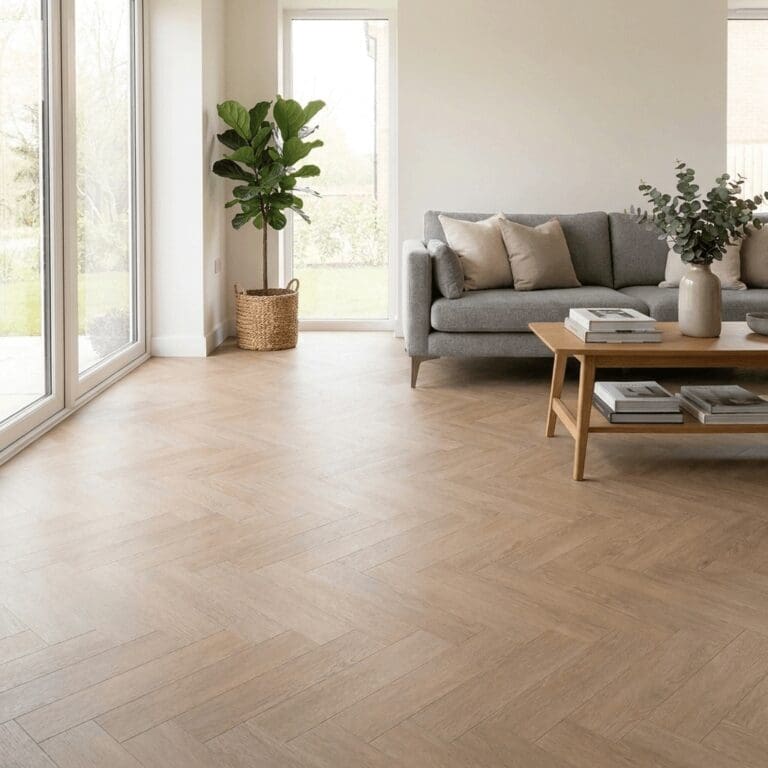
What is GF Flooring?
Premium flooring, without the premium price
Glue-down LVT, click SPC and real oak engineered wood in more than 250 designs, with clear specifications and long guarantees.
See the GF range →Step 4: Install Click LVT (Floating Method)
If your underlay is separate from the product (some SPC boards like our GF SPC range have built-in IXPE underlay), roll it out across the entire floor and tape the seams. Start along the longest or most visible wall, placing 5-10mm expansion spacers between the boards and the wall.
Angle the long edge of the first plank against the wall (tongue facing out), then click the next plank into the short end. Continue along the row. At the end, measure and score the final plank with a utility knife and straight edge, then snap it cleanly. Use the offcut to start the next row if it is at least 150mm long. Angle the long edge of each new row into the previous row’s groove, press down to engage the lock and tap gently with a tapping block if needed. Maintain expansion gaps on all sides and around all fixed objects.
For the final row, cut planks to width and use a pull bar to lever them tight. Once complete, remove all spacers and fit skirting or Scotia beading – fixed to the wall, not the floor – to cover the expansion gap.
Step 5: Install Glue-Down LVT
Glue-down LVT demands more skill than click but delivers a superior long-term result. The critical factor is adhesive timing – you need to work within the adhesive’s open time, which varies by product and room temperature.
Spread adhesive onto the subfloor (not the tile) using a notched trowel – typically a V1 or V2 notch for standard dryback LVT, or the specific notch size recommended by the adhesive manufacturer. Work in sections of roughly 3 to 4 square metres at a time. Allow the adhesive to become tacky before placing tiles – this is critical. With pressure-sensitive adhesives, the surface should feel sticky but not wet when you touch it with a knuckle. With wet-set adhesives, follow the manufacturer’s stated open time, typically 20 to 40 minutes depending on temperature.
Press each plank or tile firmly into position, butting tightly against the previous piece – glue-down LVT does not require expansion gaps because the adhesive holds it rigid. After laying each section, roll the floor with a 45kg (100lb) floor roller to ensure full contact and eliminate air pockets. Wipe up any adhesive that squeezes onto the tile face immediately – dried adhesive is extremely difficult to remove without damaging the surface.
For herringbone patterns, lay a straight guide batten along your centre line, set the first pair of blocks into the adhesive in a V shape and work outwards row by row. Products like Nordikka Tromso Herringbone, Karndean Art Select herringbone and Amtico Signature herringbone are all designed for glue-down fitting. Check alignment with a straight edge every few rows – once the adhesive grabs, repositioning is very difficult.
Step 6: Install Loose-Lay LVT
Installation is straightforward: lay loose-lay planks directly onto the clean, dry subfloor, butting them tightly together. No adhesive, no click mechanism, no underlay. The heavy backing and friction-grip base hold the planks in place. Use double-sided tape at doorways and under any edge that might be kicked or lifted. Trim planks to fit around obstacles with a sharp utility knife and straight edge.
Loose-lay is ideal for utility rooms, rental properties and commercial spaces where speed and removability matter.
Step 7: Fitting Around Obstacles
LVT cuts far more easily than wood or ceramic – a sharp utility knife and a straight edge will handle most cuts cleanly. For straight cuts, score the face with the knife, then snap the plank along the score line. For curved cuts around pipes or toilet bases, use a template cut from card and transfer the shape onto the tile, then cut with the knife or a jigsaw.
For door frames, use an offcut of your LVT (plus underlay if applicable) as a depth guide and undercut the architrave with a flush-cut saw or multi-tool so the tile slides underneath. This gives a much cleaner finish than trying to cut the LVT to fit around the frame. In kitchens and bathrooms, apply a bead of silicone sealant where the LVT meets baths, shower trays and kitchen plinths to prevent water ingress – but do not silicone the expansion gap on click floors, as the floor must be free to move.
Step 8: Finishing Touches
At thresholds between rooms, fit a transition strip or T-bar profile suited to the LVT thickness. If your LVT meets a different floor type – common in hallways across homes in Altrincham, Bowdon, Hale and Sale – a metal or colour-matched T-bar provides a clean, durable junction.
For glue-down installations, keep foot traffic off the floor for at least 24 hours to allow the adhesive to cure fully. For click and loose-lay, the floor can be walked on immediately but wait 24 hours before moving heavy furniture back in.
Room-Specific Installation Advice
Kitchens and Bathrooms
LVT is fully waterproof at the surface, making it an ideal choice for kitchens and bathrooms. In wet areas, glue-down installation is preferred because there are no joints for water to penetrate – the tiles form a continuous, sealed surface. If you choose click LVT in a bathroom, seal the perimeter with silicone and consider a product with a built-in waterproof core like our GF SPC range, which is fully waterproof through the core as well as the surface.
Conservatories
Conservatory LVT needs to cope with wider temperature swings than any other room. SPC products handle this better than standard dryback because the rigid stone-polymer core resists expansion and contraction. If using glue-down in a conservatory, use a high-quality flexible adhesive that can accommodate thermal movement and consider blinds or UV window film to reduce extreme heat build-up in summer.
Hallways and High-Traffic Areas
For hallways and dining rooms that see heavy foot traffic, choose a product with a thicker wear layer – 0.55mm as a minimum for residential hallways and 0.7mm or above for areas with regular outdoor footwear. Glue-down installation is the most durable option in these zones because it eliminates any lateral movement underfoot.
Common LVT Installation Mistakes and How to Avoid Them
We see the same installation failures come through our Altrincham showroom regularly. The most damaging mistakes are: a subfloor that was not levelled properly (bumps and ridges telegraph through within weeks), skipping acclimatisation (causing tiles to contract and gaps to open), laying glue-down LVT onto wet or tacky adhesive before it has reached the right tack (causing tiles to slide or lift), using the wrong adhesive for the product or subfloor type and missing expansion gaps on click floors (leading to buckling when the floor expands in warm weather). Every one of these is entirely preventable with proper preparation.
DIY or Professional Installation?
Floating a click LVT or SPC floor in a straightforward rectangular room is a realistic weekend project for a competent DIYer. The click profiles on modern products like our GF SPC range are designed to be forgiving and the planks cut easily with a utility knife.
Glue-down LVT is a different level of skill. Getting the adhesive timing right, keeping herringbone patterns straight over a full room and achieving a perfectly flat result all require experience. The subfloor preparation alone – levelling, priming, moisture testing – can take longer than the actual laying. For premium products like Amtico Signature or Karndean Art Select, professional installation is almost always worth the investment to protect what is a significant outlay on materials.
If you are local to Altrincham, Hale, Bowdon, Knutsford, Wilmslow, Sale, Timperley or anywhere else across South Manchester and Cheshire, we can recommend experienced local installers who fit LVT daily and know how to handle everything from complex herringbone patterns to tricky subfloor conditions in older properties.


Free tool · Room Visualiser
See any of our floors in your own room
Upload a photo of your room, choose a design, and in about 30 seconds you will see how it could look. It is free, and we email you a copy to keep.
- 1Choose a design
- 2Upload your room
- 3See it, then sample it
Choose Your LVT Flooring
If you are still deciding on your flooring, visit the Grosvenor Flooring Smart Showroom at 82 Stamford New Road, Altrincham, WA14 1BS. It is open 24/7 – visit our Altrincham showroom page to request your free door code and walk in at a time that suits you. Inside you will find our full GF LVT and GF SPC collections alongside samples from Amtico, Karndean, Nordikka, Invictus, Brampton Chase and more – so you can compare thickness, format, wear layer and finish side by side before committing.
Browse our complete LVT flooring range online, or visit our Altrincham showroom page to request your door code and see everything in person. Whether you are fitting the floor yourself or having it professionally installed, starting with the right product makes every step easier.
Who leads our guides
Managing Director, Grosvenor Flooring
Adam Williams is Managing Director of Grosvenor Flooring in Altrincham. He sets the standards our guides are written to and guides the team that reviews them, so the advice matches the floors we supply, the manufacturers' specifications and the way the fitters we work with install them.
More about Adam →Floor Finder
Not sure which floor to choose?
Answer a few quick questions about your room, who uses it and the look you like. Floor Finder picks the designs that suit you best, with prices per m² and a rough cost for your room.
Start Floor FinderFrequently Asked Questions
Can I install LVT flooring myself?
Click LVT and rigid-core SPC in a straightforward rectangular room are realistic DIY projects for a competent home fitter. Glue-down LVT is more demanding – adhesive timing, herringbone alignment and achieving a fully flat result all require experience. For premium ranges like Amtico Signature or Karndean Art Select, professional installation is almost always worth the investment.
How long does it take to install LVT flooring?
A single-room click LVT install takes a day for a competent DIYer. Glue-down LVT in the same room takes 1-2 days once the subfloor is prepared. Subfloor preparation (levelling, moisture testing, priming) can add another 1-2 days depending on the starting condition. Herringbone and pattern layouts take significantly longer than straight plank.
Do I need underlay for LVT?
Not always. Rigid-core SPC products often have built-in IXPE acoustic underlay so no separate underlay is needed. Standard click LVT without a pre-attached underlay uses a thin (typically 1-1.5mm) acoustic underlay. Glue-down LVT does not use underlay at all – the tiles bond directly to the subfloor. Check the product spec before ordering.
Can LVT be installed over underfloor heating?
Yes. LVT is one of the best flooring types for underfloor heating because it is thin and thermally conductive. Glue-down installation is preferred over UFH because there is no air gap between the tile and the heat source. Commission the heating system and run it at operating temperature for at least two weeks before fitting, then reduce to 18 degrees C for 48 hours before installation. Never exceed 27 degrees C at the floor surface during normal use.
Can LVT be installed over existing flooring?
Click LVT and SPC can often be laid over existing hard flooring – laminate, vinyl, ceramic tiles – as long as the existing surface is level, firmly bonded and in good condition. Glue-down LVT is more demanding: the adhesive needs a clean porous surface to bond to, so it generally cannot be laid over existing vinyl, laminate or tiles without first applying a primer or skim coat.
What is the difference between click and glue-down LVT?
Click LVT has interlocking edges that lock together and float over an underlay, not bonded to the subfloor. Glue-down LVT is bonded directly to the subfloor with adhesive. Click is faster to install, DIY-friendly and easier to lift. Glue-down produces a more solid underfoot feel, works better with underfloor heating and is required for herringbone and chevron patterns.
Further Reading
 Glue-down vs click LVT – which format wins for your home10 min read
 Click LVT flooring in the UK – complete guide15 min read
 Best LVT flooring in the UK – 2026 guide16 min read
 The ultimate guide to LVT flooring maintenance10 min read
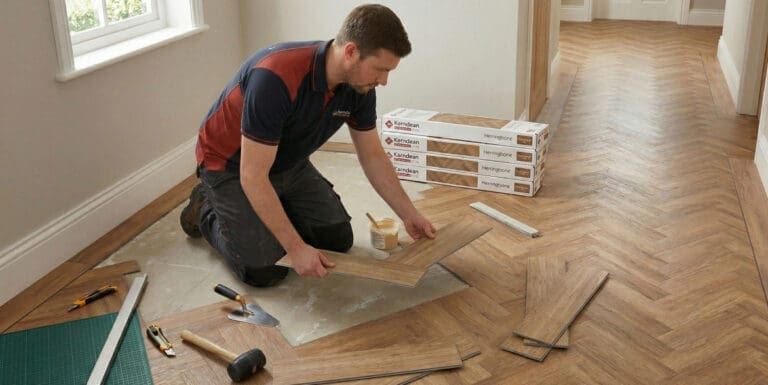 Karndean fitters guide to installing parquet herringbone3 min read
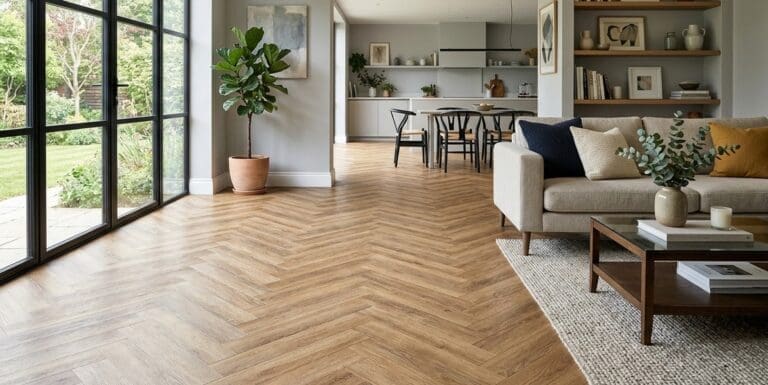 Amtico laying patterns guide11 min read
 LVT vs laminate flooring10 min read
GF by Associated Weavers
Premium-spec glue-down, fairly priced
0.55mm wear layerPlank & parquet25-year warranty
Shop the range →