






Buying Guides · 14 min read
Best Flooring for Period Properties: Restoration-Friendly Wood and LVT
 Reviewed by our team, led by Adam Williams, Managing Director
A period property deserves flooring that respects the character of the building — not something that looks plonked into a Victorian terrace or sat on top of a Georgian townhouse floor. The wrong flooring choice in a period home reads as cheap immediately; the right one disappears into the architecture and lets the original features do the talking.
In this article
- What Counts as a Period Property?
- Engineered Wood: The Default Choice for Period Properties
- Herringbone Parquet for Edwardian and 1920s Properties
- Versailles Parquet for Georgian Properties
- Wide-Plank Wood for Georgian and Country Houses
- Restoring Original Floorboards: When It Makes Sense
- Victorian Tile Effect Vinyl Flooring
- LVT for Period Properties: Where It Belongs
- Practical Considerations in Period Property Renovations
- Underfloor Heating in Period Properties
- Pets, Children and Period Properties
- See It in Person: Our 24/7 Smart Showroom
- Order Free Samples
- Frequently Asked Questions

This guide covers the realistic flooring options for period properties in 2026: when to restore the original boards (and when not to), when engineered wood is the right replacement, where herringbone or Versailles parquet belongs, where wide-plank wood works and which scenarios call for authentic-looking LVT instead. We will cover Victorian, Edwardian, Georgian, mid-century and Listed building considerations, plus the practical issues (uneven subfloors, draughts, joist exposure) that every period-property renovation has to navigate.
What Counts as a Period Property?
For flooring purposes, a period property is any home built before roughly the 1960s where the original architecture and detailing is part of the value. The eras have different characteristics that affect flooring choice:
Georgian (1714-1837) — wide oak floorboards (typically 200-300mm wide), often pegged rather than nailed, sometimes painted. Strong proportions and symmetry, period detailing including cornicing, dado rails and sash windows. Flooring needs to suit a formal, generously proportioned interior.
Victorian (1837-1901) — narrower pine floorboards (typically 100-150mm wide), often laid over joists in two-storey terraces. Decorative tiled hallways, pattern-encaustic tile or geometric tile floors in entrance halls and bathrooms. Floorboards in main rooms were originally covered with rugs over polished or stained surfaces.
Edwardian (1901-1910) — similar pine boards to Victorian but in slightly larger properties with more generous room proportions. Parquet flooring became fashionable in this era for premium homes. Decorative tile work continued.
Inter-war and post-war (1918-1960s) — smaller pine boards, sometimes parquet block flooring in better properties, often with a mix of timber and tile across the ground floor. 1950s and 60s saw the introduction of vinyl sheet flooring in kitchens and bathrooms.
The right flooring for a period property usually means either restoring or re-creating the original look — not introducing a contemporary design that fights the architecture.
Engineered Wood: The Default Choice for Period Properties
For most period property renovations, engineered wood is the right answer. It gives you the look and feel of solid timber but with significantly better dimensional stability, which matters in period homes that often have draughty subfloors, variable humidity and limited under-floor ventilation. Engineered wood is also compatible with the underfloor heating that is increasingly retrofitted into period kitchens and bathrooms — solid wood is not.
The construction (a real timber top layer bonded to a multi-layer plywood core) means engineered wood looks identical to solid wood when fitted but moves less with seasonal changes. Over Cheshire winters with central heating running and Cheshire summers with windows open, that stability is the difference between a floor that looks beautiful for thirty years and one that gaps and cups within five.
V4 Engineered Wood
V4 is a strong choice for period properties at the mid-range price point. The Heritage and Tundra collections offer the wider plank widths suited to Georgian properties and the smoked oak finishes that work well in Victorian and Edwardian interiors. See our full V4 engineered wood guide for the range breakdown.
Ted Todd Engineered Wood
Ted Todd is the premium engineered wood specifier for period properties. The Reclaimed and Project collections include genuinely characterful planks (some made from reclaimed timber) that match Georgian and Victorian aesthetics convincingly. Particularly strong for restoration projects where authenticity matters more than budget.
Woodpecker
Woodpecker sits between V4 and Ted Todd on price and offers a strong range of oak engineered wood suitable for period homes. The Berkeley and Harlech collections are particularly suited to Victorian and Edwardian properties.
GF Engineered Wood
Our GF Engineered Wood range offers herringbone, plank and Versailles formats at a competitively priced tier. For period properties where budget is a real consideration, GF is the value choice without compromising on the multi-layer plywood-core construction that matters for stability.
Herringbone Parquet for Edwardian and 1920s Properties
Herringbone parquet was a status symbol in Edwardian and inter-war properties — particularly in hallways, formal dining rooms and parlours. If you are restoring a property from this era and find evidence of original parquet (often hidden under carpet for decades), restoring or re-creating that pattern is the strongest period-appropriate choice you can make.
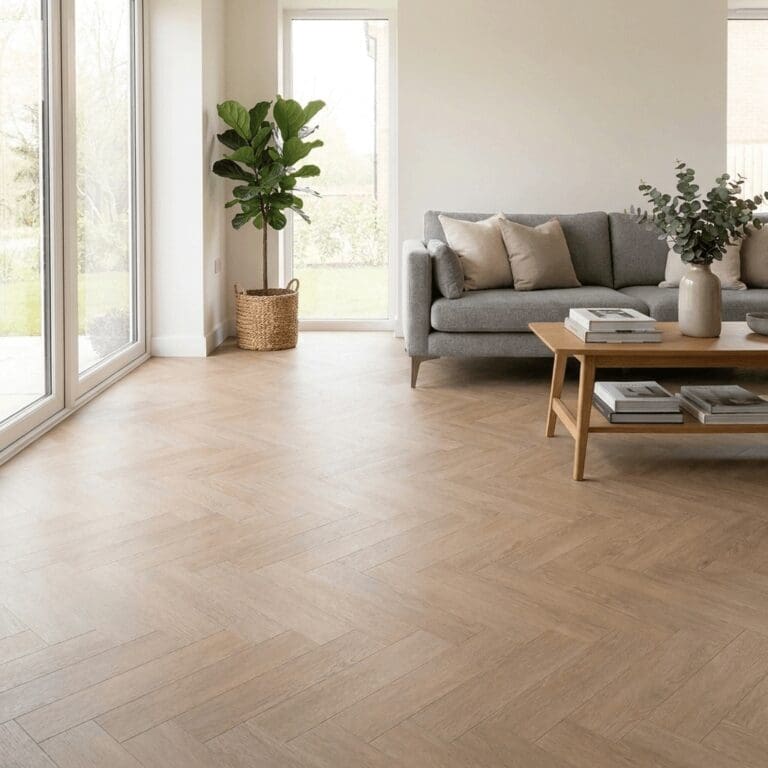
Modern engineered wood herringbone gives you the look without the install complexity of traditional parquet blocks. Each plank is a smaller piece (typically 600mm x 100mm or similar) cut to interlock at right angles. Read our complete herringbone flooring guide for a deeper look at the format.
For LVT herringbone alternatives, see Karndean herringbone, our full LVT herringbone collection and the Nordikka Tromso and Nordikka Bodo ranges.
Versailles Parquet for Georgian Properties
Versailles parquet — the geometric pattern made famous in the French royal palace — is the most ornate timber flooring you can fit. In a Georgian townhouse with high ceilings, generous proportions and original cornicing, Versailles parquet can elevate the entire room. It is overspecified for a 1930s semi but absolutely belongs in a serious Georgian or Edwardian property.
Modern engineered wood Versailles panels are constructed as single tiles (typically 600mm x 600mm or 800mm x 800mm) with the geometric pattern milled into a solid panel. Installation is faster than traditional inlaid parquet but the visual effect is similar. Our GF Engineered Wood range includes Versailles formats at accessible prices.
Wide-Plank Wood for Georgian and Country Houses
Georgian properties and country houses originally had wide-plank floorboards — sometimes 250-400mm wide pine or oak with visible pegs rather than modern nails. Modern engineered wood in plank widths of 220mm+ recreates this look. Look for boards described as “wide-plank” or “extra-wide” (often 220-300mm) with a hand-scraped or wire-brushed finish that approximates the texture of an original aged board.
For Cheshire farmhouse renovations and Georgian townhouse work, wide-plank engineered oak is often the natural specification. V4’s Tundra and Ted Todd’s Project ranges include suitable products.
Restoring Original Floorboards: When It Makes Sense
Sometimes the right flooring decision is to keep what is already there. Original Victorian, Edwardian and Georgian floorboards (typically pine, occasionally oak) can often be sanded, repaired, stained and sealed for a fraction of the cost of replacement. The result is genuinely original, which engineered wood can only approximate.
Restoration makes sense when: the boards are largely intact, the joists below are sound and you are willing to live with the imperfections that come with 100+ year-old timber (some gaps, some movement, some visible repair patches). It does not make sense when: the boards are too damaged, the subfloor is unsound, you need underfloor heating, or the property has been converted in a way that has disturbed the original layout.
For most period property renovations, the realistic choice is engineered wood that approximates the original look but delivers modern performance — particularly important if you are fitting UFH or need a more stable floor for furniture, rugs and modern living.
What is GF Flooring?
Premium flooring, without the premium price
Glue-down LVT, click SPC and real oak engineered wood in more than 250 designs, with clear specifications and long guarantees.
See the GF range →Victorian Tile Effect Vinyl Flooring
Victorian and Edwardian properties originally had decorative tile floors in hallways, entrance halls and bathrooms — black-and-white geometric patterns, encaustic Minton tiles, tessellated borders. These original tile floors are some of the most period-appropriate flooring you can have and where they survive, they should generally be restored rather than replaced.
Where the original tile has been lost or was never present, modern Victorian tile effect vinyl flooring delivers the same visual impact with significantly easier installation and maintenance. Tile-effect LVT in black-and-white geometric patterns, decorative encaustic designs and traditional Minton-style motifs all work for Victorian and Edwardian restoration projects. The visual replication of authentic Victorian tile is good enough that the difference reads only on close inspection.
The format works particularly well for:
Victorian hallways. The classic black-and-white geometric or chequerboard tile floor is the defining feature of a Victorian terrace entrance hall. Tile-effect LVT in this pattern is widely available and restores the period feel in a single day of installation.
Edwardian and 1920s bathrooms. Decorative pattern tile floors were common in better-class bathrooms of this era. Modern pattern-tile LVT in geometric, hex-tile and encaustic designs all work.
Period property hallways generally. Where the original tile is too damaged to restore, a tile-effect LVT replacement maintains the architectural character without the cost or installation complexity of new ceramic tile.
Browse our Karndean Knight Tile range for traditional tile-effect designs, including Victorian-appropriate stone and tile patterns. Amtico Spacia also offers strong stone-effect and tile-effect designs at the entry-premium tier. For dedicated pattern designs, see our broader LVT collection.
LVT for Period Properties: Where It Belongs
Engineered wood is the default for living rooms, hallways, dining rooms and bedrooms in period properties. But LVT has a legitimate place in three specific scenarios:
Kitchens. Original Victorian and Edwardian kitchens often had tile or quarry floors. Modern period-property kitchens benefit from waterproof flooring (which solid or engineered wood is not). Stone-effect LVT recreates a flagstone or tile look without the cold, hard underfoot feel of real stone. Wood-effect LVT in plank or herringbone works if you want the warmth of wood without the moisture exposure risk. For a full kitchen breakdown, see our best kitchen flooring guide.
Bathrooms. Bathrooms in period homes need to be fully waterproof. LVT is the right specification. Stone-effect or wood-effect tile-format LVT works well in Victorian and Edwardian bathrooms; herringbone LVT can suit Edwardian and 1920s properties. See our best flooring for bathrooms guide.
Utility rooms, sculleries and back kitchens. The functional spaces in period homes were originally tile or stone for practical reasons. Modern LVT in tile-effect designs maintains the period feel while delivering modern waterproofing and ease of cleaning.
What LVT should not do in a period property: replace wood in formal rooms, hallways or bedrooms where the architecture calls for real timber. Even excellent wood-effect LVT reads as “not real wood” in a formal Georgian dining room and undermines the building’s character.

Customer reviews
Rated Excellent by our customers
- 4.8★Google rating from 145+ reviews
- 192Verified reviews on Trustindex
- 25+Years supplying and fitting floors
Practical Considerations in Period Property Renovations
Uneven Subfloors
Period property subfloors are rarely flat. Joists have moved over a century or more, sometimes substantially. Modern flooring expects a level subfloor to within tight tolerances. The realistic approach is either to specify rigid-core SPC or click engineered wood (both of which bridge minor imperfections better than glue-down LVT) or to budget for self-levelling compound before installation. Get the subfloor right and the floor performs; ignore it and even premium flooring will telegraph the underlying problems.
Limited Subfloor Ventilation
Victorian and earlier properties were built without modern damp-proofing. Suspended timber floors over earth or rubble subfloors need ventilation to prevent moisture build-up that can rot the joists. Restoration work that improves insulation can sometimes block existing airbricks or vents. Always commission a competent surveyor to assess the subfloor ventilation before committing to a new floor.
Listed Buildings and Conservation Areas
Listed building consent may be required for substantial flooring changes in a Grade I or Grade II Listed property. Even where consent is not strictly needed, period-appropriate materials and methods are usually preferred. Conservation officers will generally accept high-quality engineered wood replacing damaged solid wood, but original parquet or featured floors usually need to be restored rather than replaced. Check with your local planning authority before specifying flooring in a Listed building.
Floor Heights and Door Clearances
Period properties often have tight door clearances and changing floor height through renovation can mean planing or replacing doors. Engineered wood at 15-21mm thickness over a 3mm underlay adds 18-24mm to the floor height. LVT at 2-2.5mm is much shallower. SPC at 4-6mm including underlay sits between. Plan the floor build-up early in the renovation; do not leave it until after kitchens, doors and skirting have been fitted.
Skirting and Architrave
Period skirting boards are often deep (150-300mm) and architecturally important. The floor needs to be specified and laid in a way that respects the skirting — usually with a 10-15mm expansion gap concealed by quadrant beading or, more elegantly, by undercutting the skirting before fitting and slotting the new floor underneath. Avoid scotia beading that sits proud of period skirting; it looks wrong.
Underfloor Heating in Period Properties
Retrofitting UFH is increasingly common in period property kitchens, bathrooms and extensions. The flooring needs to be UFH-compatible. Engineered wood works with careful specification (narrow planks, stable construction). LVT and SPC work well. Solid wood does not work over UFH and should be avoided. For a complete breakdown, see our best flooring for underfloor heating guide.
Pets, Children and Period Properties
Period properties often house families and pets. The flooring needs to handle daily life as well as look the part. For households with dogs in particular, the right specification is engineered wood with a hard-wearing finish (oiled rather than lacquered for ease of touch-up) or wide-plank LVT in a wear-layer of 0.55mm or above. For full guidance, see our best flooring for dogs guide.
See It in Person: Our 24/7 Smart Showroom
Period properties reward thoughtful flooring choices that you cannot really evaluate from a screen. Plank widths, grain patterns, finish texture and colour all read differently in a sample than they will in your hallway. Our 24/7 Smart Showroom in Altrincham is open any hour of day or night — no appointment needed. Request your access code online or scan the QR code on the front of the showroom and visit when it suits you. See engineered wood, herringbone and Versailles formats laid at full plank length in our Wood Room. The showroom is also signposted on our Altrincham showroom page.
Order Free Samples
Period-appropriate flooring is a long-term decision. Order up to five free samples from any of our engineered wood, herringbone, Versailles or character LVT ranges and test them in your actual rooms — against your existing skirting, in your existing lighting and alongside your existing fittings — before committing. Browse our full engineered wood collection and add samples to your basket. Working on a substantial restoration project? Get in touch — the team will discuss your property era, room layout and aesthetic priorities and recommend the right ranges to consider.
Who leads our guides
Managing Director, Grosvenor Flooring
Adam Williams is Managing Director of Grosvenor Flooring in Altrincham. He sets the standards our guides are written to and guides the team that reviews them, so the advice matches the floors we supply, the manufacturers' specifications and the way the fitters we work with install them.
More about Adam →Floor Finder
Not sure which floor to choose?
Answer a few quick questions about your room, who uses it and the look you like. Floor Finder picks the designs that suit you best, with prices per m² and a rough cost for your room.
Start Floor FinderFrequently Asked Questions
What is the best flooring for a period property?
Engineered wood is the best all-round flooring for most period properties. It delivers the look and feel of solid timber with significantly better dimensional stability for period homes that often have variable humidity, draughty subfloors and retrofitted underfloor heating. For Edwardian and 1920s properties, engineered wood herringbone is particularly authentic. For Georgian and country houses, wide-plank engineered oak with a hand-scraped or wire-brushed finish is the natural choice.
Should I restore the original floorboards or replace them?
Restore if the boards are largely intact, the joists are sound and you can accept the natural imperfections of 100+ year-old timber. Replace with engineered wood if the original boards are too damaged, the subfloor is unsound, you need underfloor heating or you want a more consistent, contemporary finish. There is no universally right answer — it depends on the condition of the original floor and your renovation priorities.
Can I use LVT in a period property?
Yes, in specific rooms. LVT is the right choice for kitchens, bathrooms and utility rooms in period homes where waterproofing matters. Stone-effect and wood-effect LVT in tile or herringbone format works well with Victorian, Edwardian and earlier architectural styles. Avoid LVT in formal rooms (drawing rooms, dining rooms, hallways) where the architecture calls for real wood — even excellent LVT reads as “not real wood” in a serious period interior.
What flooring suits a Victorian terrace?
Engineered wood in 130-180mm plank widths is the typical choice for a Victorian terrace — replicating the original narrower pine boards but with modern stability and finish options. Smoked oak, fumed oak and natural oak finishes all work. For Victorian hallways, original tiles (if extant) should be restored; otherwise specify tile-effect LVT or geometric tile to maintain the period feel. Bathrooms should be LVT or tile.
What flooring suits a Georgian property?
Wide-plank engineered oak (220mm+ width) in a hand-scraped or wire-brushed finish for living rooms, dining rooms and bedrooms. Versailles parquet for formal hallways and entrance halls. Engineered wood herringbone for studies and breakfast rooms. LVT for kitchens, bathrooms and utility rooms only. Avoid contemporary-looking flooring patterns that fight the building’s symmetry and proportion.
What about parquet flooring in a period property?
Parquet (herringbone, Versailles, basketweave or other geometric patterns) is highly period-appropriate for Edwardian, 1920s-1930s and Georgian properties. Modern engineered wood parquet gives you the look with much faster installation than traditional inlaid blocks. Versailles parquet panels suit Georgian formal rooms; herringbone suits Edwardian and inter-war properties. Read our herringbone flooring guide for more.
Is engineered wood suitable for Listed buildings?
Usually yes with appropriate specification. Conservation officers will generally accept high-quality engineered wood as a replacement for damaged solid wood, particularly where the original timber cannot be saved. Listed building consent may be required for substantial flooring changes — check with your local planning authority before committing.
Can I fit underfloor heating in a period property?
Yes — electric UFH retrofits well in period property kitchens and bathrooms. Wet UFH is more involved but feasible during a substantial renovation. The flooring needs to be UFH-compatible. Engineered wood (with care), LVT and SPC all work; solid wood does not. See our best flooring for underfloor heating guide for more.
Do you do free samples of period-appropriate flooring?
Yes — engineered wood, herringbone, Versailles and character LVT samples can all be ordered free from our website. Up to five samples per online order, posted free, typically delivered in 2-3 working days. Full details on the flooring samples page.